|
 |
|||||||
 |
 |
 |
||||||
 |
 |
 |
 |
 |
||||
| |
 |
 |
 |
 |
 |
 |
|
|
 |
||||||||
| |
|
|||||||
| |
|
|
||||||
| |
|
|
|
|
||||
| |
|
|
|
|
|
|
|
|
| |
||||||||
Both the Circumnavigational and Jumping Wall puzzles came from an idea I had during the summer of 2001 at a coffee house in Cleveland. While the Jumping Wall puzzles were far more difficult to take from concept to actual puzzle (in fact, it took more than a year before I solved certain core hurdles in their construction), the Circumnavigational puzzles were no cake walk.
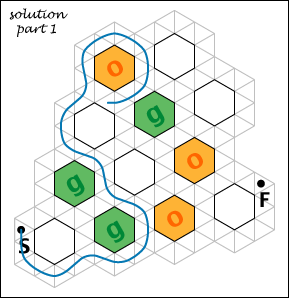
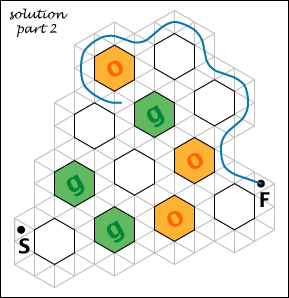
Puzzle 1 was the first puzzle, after the example shown with the instructions, that I made. It took some time to understand how different combinations of orange and green hexagons would limit or enable certain movements in the puzzle, but the first lesson I had to learn was to trim extraneous blank hexagons from the outside of the physical problem space. I started with a huge blob of hexagons and a few orange/green ones in the middle. There were so many blank hexagons that I could go from start to finish, completely circumnavigating the colored hexagons entirely! After removing some of the blank hexagons, the puzzle looked like this:
Second, I had originally placed the finish dot in a location between two orange hexagons. After a while, I became quite nervous about this, since it might be interpreted that you needed to "touch" the last orange hexagon to complete the puzzle, which was impossible. In moving the finish dot away from the orange hexagons, I knew one of the blank hexagons had to be removed, in order to prevent a solution that hugged the right hand side of the puzzle.
I thought that the puzzle was finished at that point. However, in making more of the Circumnavigational puzzles, I realized that there were several other, unintended solutions that utilized looping. It was only in creating several of these puzzles that I discovered looping as a problem solving technique. But that meant I needed to go back and check some of the earlier puzzles, and sure enough, looping could be used to find alternate solutions to many of them.
For example, the loops here in red could be taken as many times as you wanted, because each loop produced additional pairing(s) of green and orange hexagon passes. The first produces one additional pair per pass, the second produces two additional pairs per pass. This isn’t so bad, since presumably we're interested in the shortest possible solution, so lopping around and around and around doesn’t really detract from the original solution. For all other Circumnavigational puzzles, I didn’t worry myself to mush about these kind of loops.
But there were still more looping problems. In such a small puzzle, it was difficult to make it challenging by allowing some choice of possible paths while at the same time ensuring only one possible solution. By retaining a couple of empty hexagons on the right side of the puzzle, I thought it allowed for a few dead end paths but no more solution paths. Unfortunately, by looping around the top orange hexagon, you can pass the green hexagon while still going around the orange hexagon, then make your way to the orange hexagon near the finish dot.
I typically try to ensure that there is only one solution to my puzzles, but in this case, I felt that in order to do that, I would have to add to the puzzle, something which I really didn’t want to do. The first puzzle in a series should act as sort of an extended example, not to tough, something to get your feet wet. Thus I decided to just leave well enough alone. If you found the looping solution before reading it here, well, you were one step ahead of me when I created the puzzle.
Last updated: January 26, 2004
Copyright © 2000-2004 All Rights Reserved