 |
 |
|||||||
 |
 |
 |
||||||
 |
 |
 |
 |
 |
||||
| |
 |
 |
 |
 |
 |
 |
|
|
 |
||||||||
| |
|
|||||||
| |
|
|
||||||
| |
|
|
|
|
||||
| |
|
|
|
|
|
|
|
|
| |
||||||||
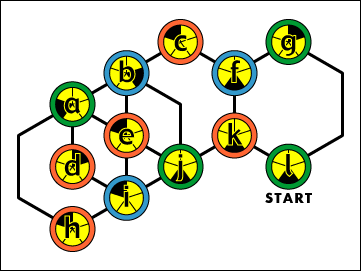
If you haven't read the comments on the drawing board for the first Circle Rotation puzzle, you should go back and read those before you read these. Briefly, it is a summary of a procedure for solving the puzzle by force, instead of looking for the shortest solution. In the forced method, you jump between two circles until one of the circles is in the correct position, then keeping the one circle that is still out of position, you start jumping between a new pair. [For those of you who actually try this, the endgame for this method may require jumping between a triad of circles to get them all in the right position at the right time, depending upon which order you choose to align the circles.]
For the mathematically inclined out there, this forced method is brought to you by the letter Z and the number five. Since five is a prime number, no matter what number of positions a circle turns when you land on it, in order to get it back to its starting position, you will have to land on it a total of five times when jumping from the same color. For example, jumping from green to red means that the red circle rotates two positions in the clockwise direction. In order to get the red circle back to the original position, you'd have to move from green red a total of five times, which would rotate the circle ten positions, or twice around. There is no faster route. Likewise, jumping from red to green means that the green circle rotates four positions in the clockwise direction. In order to get the green circle back to the original position, you'd have to move from red to green a total of five times, which would rotate the circle twenty positions, or four times around.
If the circle had a different number of sections, say four or six or some other non-prime (composite) number, then there would be "shortcuts" to getting back to the original position. Not every rotation would constitute a shortcut, but every rotation number which has a common factor with the number of circle sections would. For example, say we had six circle sections instead of five, but the same types of rotations listed above. Jumping from green to red means that the red circle rotates two positions in the clockwise direction. In order to get the red circle back to the original position, now we'd only have to move from green red a total of three times, which would rotate the circle six positions, or once around. Likewise, jumping from red to green means that the green circle rotates four positions in the clockwise direction. In order to get the green circle back to the original position, now we'd only have to move from red to green a total of three times, which would rotate the circle twelve positions, or two times around.
The circle rotations in the puzzle work in something that algebraists call Z5, which is essentially the integers modulo five. If you think of a clock that only had five hours on it, then the hours (whatever we called them, but typically 0, 1, 2, 3, and 4) would constitute Z5, and moving around the clock would constitute addition and subtraction. Three hours after four o'clock would be two o'clock, six hours before one o'clock would be zero o'clock, etc....
Of course, the blue to blue jump, in which there is no rotation whatsoever, is an exception. Also, moving around the puzzle and landing on the same circle from different colors will produce different combinations of rotations.
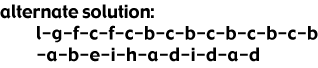
Below is an alternate solution to this puzzle, using the discussed technique.

Last updated: September 1, 2003
Copyright © 2000-2003 All Rights Reserved