|
 |
|||||||
 |
 |
 |
||||||
 |
 |
 |
 |
 |
||||
| |
 |
 |
 |
 |
 |
 |
|
|
 |
||||||||
| |
|
|||||||
| |
|
|
||||||
| |
|
|
|
|
||||
| |
|
|
|
|
|
|
|
|
| |
||||||||
This was one of the first new types of puzzles I created after moving from Chicago to Madison in 1998. A logic class I was taking that fall briefly covered partially ordered sets, and the mathematical concept instantly struck me as a good puzzle idea. Partially ordered sets have members which cannot be compared with an ordering operation (for a more detailed explanation, see the Hexagonal Ordering puzzle rules).
The rules here actually make the set of numbers in the puzzle well-ordered, even if some numbers cannot be "compared" directly with each other (in other words, you cannot jump to some numbers directly from some other numbers - hey, this is a puzzle). What I envisioned as the operator in the puzzle was a comparison like "less than", since you start at bigger numbers and move to smaller numbers. But all of the rules don't exactly follow that "less than" idea: take for example the rule covering adding a digit to your number. (7,4,8) doesn't seem "less than" (7,4). This is ok, since I can define the operation however I want to, as long as it is consistent. In addition, it seems to make the rule more difficult to remember, which in turn makes the puzzle more difficult to solve.
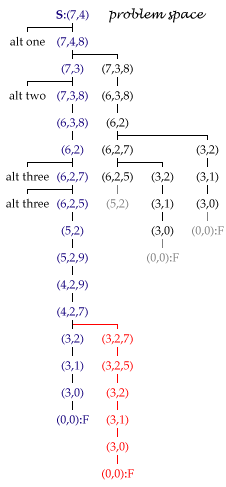
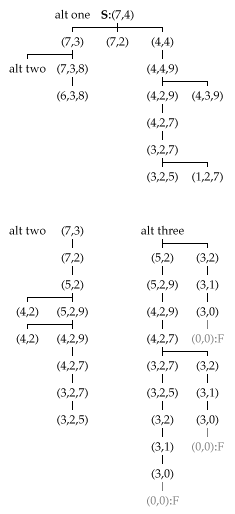
If you look carefully at the problem space at the below, you'll see that many segments of the problem space are repeated. It turns out that, from the starting hexagon, there are quite a few different starting paths offered in the middle section of the physical problem space. Most selections immediately or eventually lead to the same two exit paths from the center of the puzzle: (3,2) - (3,1) - (3,0) to the east or (5,2) - (5,2,9) - (4,2,9) - (4,2,7) to the south (which links into (3,2) - (3,1) - (3,0) two different ways). Only the correct choice of paths at the beginning of the puzzle (namely, the one which covers (6,2,5) in the finish hexagon) will lead to an exit path which actually goes all the way to (0,0). In fact, in an earlier version of the puzzle, I hadn't been careful enough to ensure that only one of the multiple choices at the beginning would lead to the finish.
There is an additional solution (marked in red) to the intended solution (marked in blue). This alternative takes advantage of the repetitive (3,2,7) - (3,2,5) moves located at the bottom of the puzzle. While I always try to avoid multiple solutions in any of my puzzles, changing either the (3,2,7) - (3,2,5) path or the (3,2) - (3,1) - (3,0) truncated the problem space significantly. So, I just left it the way it was.
Finally, this puzzle, as seen here on the web site, is right-side up. It was published upside-down in the magazine for space and aesthetic concerns, but I've returned it to its original conception here. (Of course, it wasn't really published upside-down. Just the physical problem space was upside-down, all of the numbers were right side up.)
Last updated: May 26, 2003
Copyright © 2000-2003 All Rights Reserved