 |
 |
|||||||
 |
 |
 |
||||||
 |
 |
 |
 |
 |
||||
| |
 |
 |
 |
 |
 |
 |
|
|
 |
||||||||
| |
|
|||||||
| |
|
|
||||||
| |
|
|
|
|
||||
| |
|
|
|
|
|
|
|
|
| |
||||||||
Because of my ongoing work in graduate school, I was unable to create a full set of puzzles during the summer of 2000 to cover all of the issues in Volume 8. In the fall, I worked on a few new types of puzzles, but they all turned out to be too complicated for the magazine. I was able to dig up a puzzle from my archives that had never been published (what is now called cwts Puzzle 1) and create a puzzle from an idea that I hatched a while back (mw Puzzle 3). But I was still short one puzzle by late spring in 2001, so I needed to quickly produce one more puzzle to fill the last issue of the year. I was planning on creating a new Hexagonal Ordering puzzle for Volume 9, but bumped it up because I was pretty desperate. Creating this type of puzzle is actually not all that complicated and took only a few hours from the initial idea of the layout of the solution to filling in the numbers and charting the problem space to ensure a unique solution.
The problem space below exemplifies one of the main ideas in this type of puzzle. Because there are two numbers in each hexagon, in order to use the second number, you need to have visited that hexagon once before. The numbers in the bottom right-hand corner of the puzzle were specifically created so that there are a few different ways to navigate that portion of the puzzle. Some of those paths use only a subset of the hexagons used in the actual solution. When you return to that section of the puzzle in the final steps of the solution, those alternate paths that left out a few hexagons make the final few steps inaccessible.
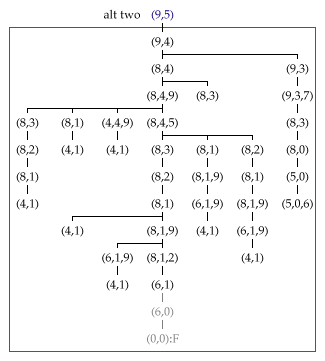
What is interesting here is that most of the rest of the puzzle is unaffected by those early decisions, and thus large chunks of the problem space are repeated. The large green box encompasses the bulk of the problem space, which is mostly contained in the loop in the upper left-hand corner of the puzzle. This green box is nearly duplicated in the "alt one" and "alt two" sections of the problem space.
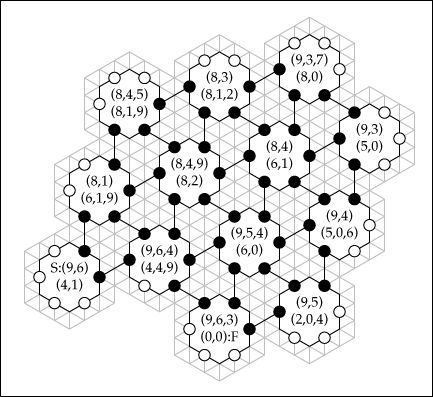
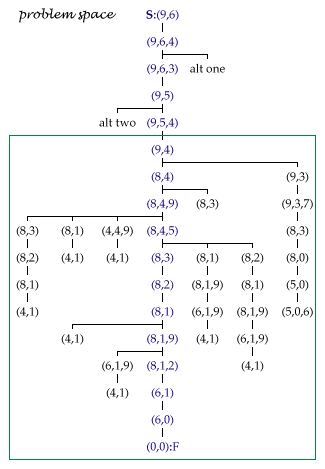
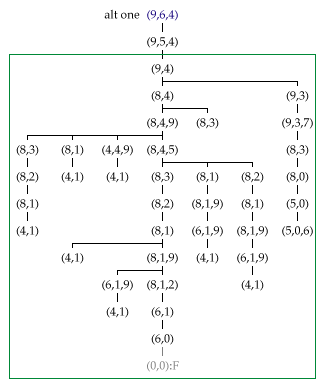
In "alt one", you jump from (9,6,4) to (9,5,4), thereby skipping (9,6,3) and (9,5). While not landing on the (9,5) hexagon isn't so bad, since the (2,0,4) number won't be used anyway, not landing on the (9,6,3) hexagon causes all sorts of trouble. This hexagon also holds the finish number (0,0), which is inaccessible if (9,6,3) is not used first. This alternate path doesn't affect the rest of the puzzle, so all of the green box part of the problem space is exactly the same until you come back to trying to move from (6,0) to (0,0).
In "alt two", you jump from (9,5) to (9,4), thereby skipping (9,5,4). Again, not landing on (9,5,4) causes all sorts of trouble. This hexagon also holds the number (6,0) (required just before jumping to the finish), which is inaccessible if (9,5,4) is not used first. This alternate path also doesn't affect the rest of the puzzle, so all of the green box part of the problem space is exactly the same until you come back to trying to move from (6,1) to (6,0) (and of course trying to move from there onto (0,0), the finish number).
Simply forgetting to jump to one number on one hexagon can make the problem unsolvable further along. It also, from a designer's perspective, can greatly enlarge the problem space, because of this duplicating effect generated by multiple early paths, without creating a lot more work to keep track of the problem space.
Last updated: December 5, 2004
Copyright © 2000-2004 All Rights Reserved